Securing a professional pest control service in San Diego protects residential framing and interior living envelopes from destructive subterranean termite colonies, wood-boring drywood swarms, and aggressive roof rat pathways. Bravion Bug Solutions executes clinical, targeted mechanical exclusion alongside localized botanical, biological, and non-repellent synthetic applications adapted to Southern California microclimates.
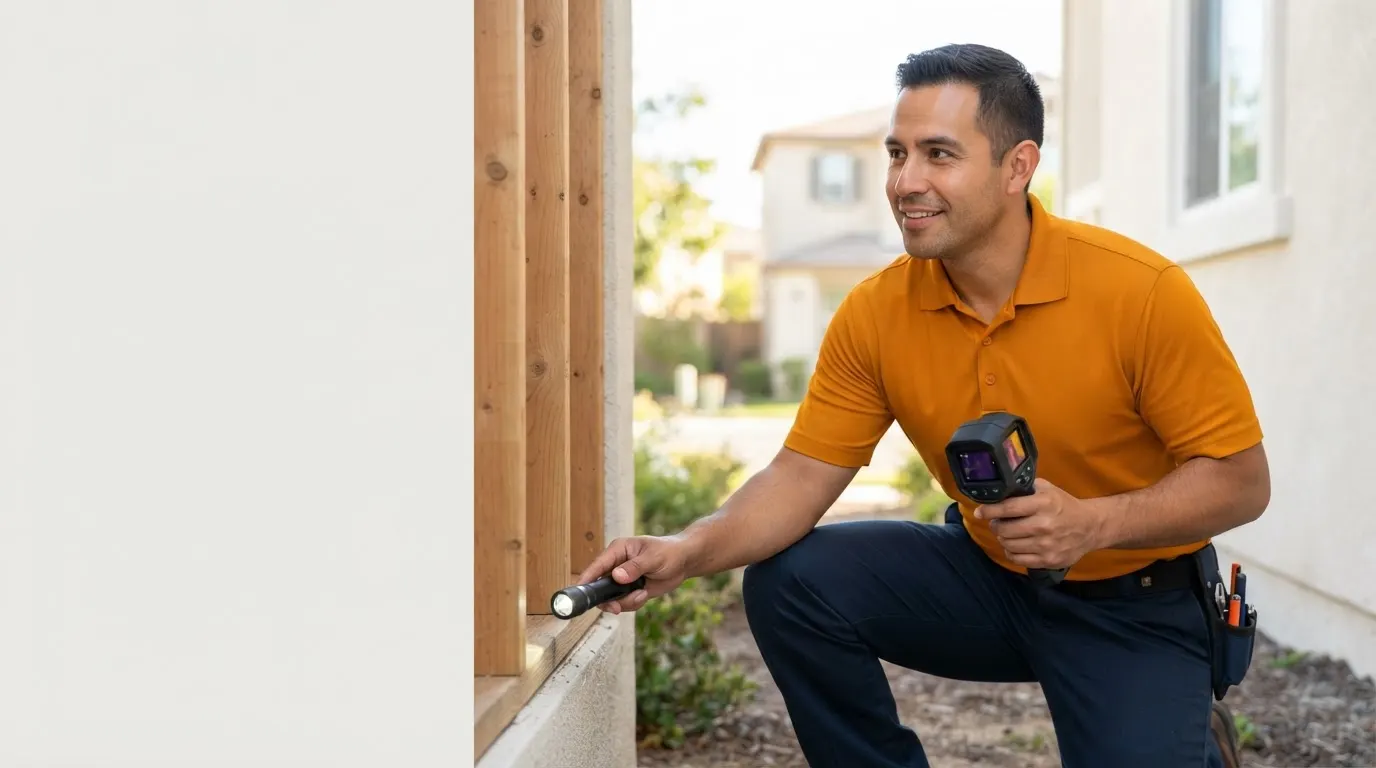
A professional pest control service in San Diego is an applied environmental health discipline that diagnoses structural vulnerabilities, neutralizes targeted invertebrate and mammalian organisms, and constructs mechanical barriers across coastal and inland residential foundations.
Every service reflects the same meticulous attention to detail, whether it's a single job or a larger pest control sevice project across San Diego.
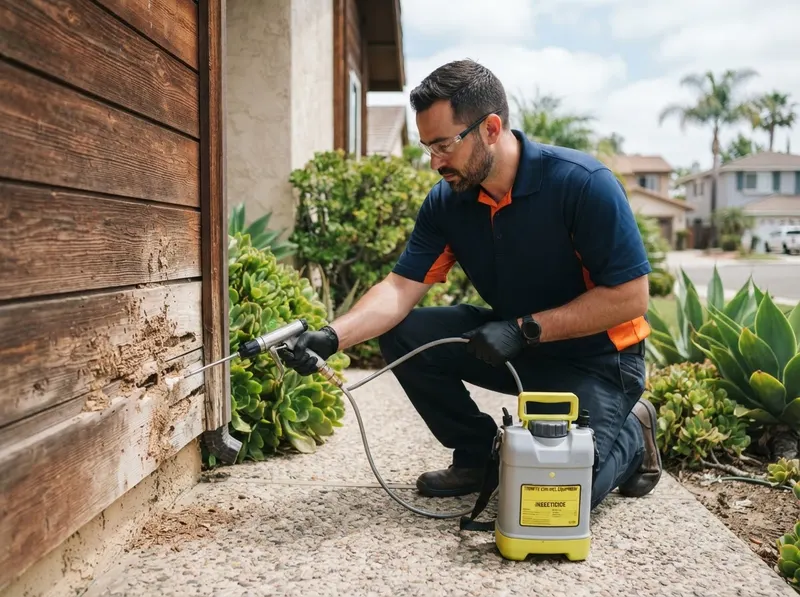
Drywood termite infestations across coastal San Diego properties typically establish inside exterior fascia boards, exposed rafter tails, window jambs, and structural roof trusses. Our precision protocol begins with high-resolution acoustic and optical fiber-optic wall void inspections to identify targeted gallery boundaries. Technicians execute direct drill-and-inject protocols, boring 1/8-inch ports into affected timber structural members to deliver localized non-repellent liquid termiticides or disodium octaborate tetrahydrate solutions under calibrated hydraulic pressure. This method saturates internal cellulose galleries, killing living nymphs, soldiers, and alates upon contact and ingestion. The borate compound crystallizes within the wood fibers, rendering the timber permanently toxic to future wood-boring digestions. Treated access holes are sealed with matching timber dowels and water-resistant structural wood filler, eliminating exterior moisture intrusion while avoiding the structural upheaval, chemical off-gassing, and multi-day property evacuation associated with sulfuryl fluoride tent fumigation.
Get a quote →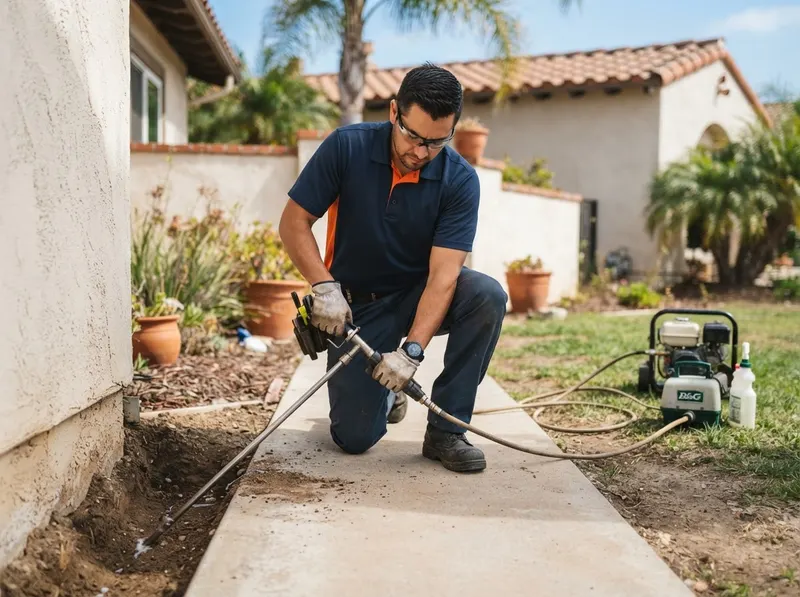
Subterranean termites originate in deep subterranean moisture layers and build protective earthen mud tubes over concrete foundations to consume structural framing. Our remediation protocol constructs a continuous subterranean chemical envelope around the complete foundation footprint. Technicians hand-trench exterior soil along stem walls to a minimum depth of 6 inches and width of 6 inches, saturating the removed soil with non-repellent liquid termiticide at a certified rate of 4 gallons per 10 linear feet. Where concrete driveways, flagstone walkways, or attached garage slabs abut foundation walls, technicians drill 1/2-inch vertical holes spaced precisely 10 to 12 inches apart through the flatwork, injecting liquid barrier solutions directly into the underlying sub-slab soil at high pressure. Because the liquid active ingredient remains undetectable to worker termites, foragers pass freely through the treated soil, cross-contaminating nestmates and queens via grooming behavior within 60 to 90 days. Every drilled slab port is subsequently patched using hydraulic, non-shrink structural concrete plug material.
Get a quote →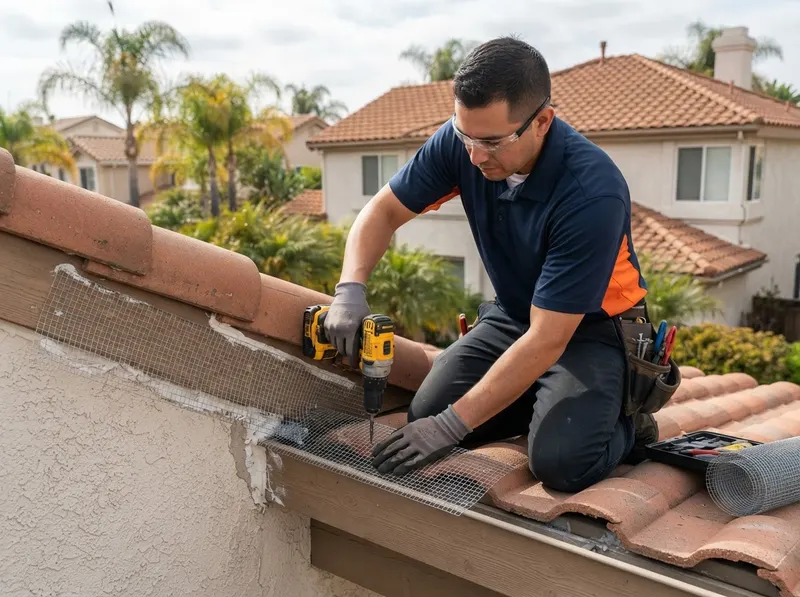
San Diego County's coastal sage and dense urban landscaping harbor substantial roof rat populations that utilize tree canopies and utility wires to access residential rooflines. Our exclusion strategy focuses on structural fortification rather than indefinite interior poisoning. Technicians execute a 36-point exterior architectural audit from foundation crawlspace screens to ridge caps. We seal all entry gaps exceeding 1/4 inch using industrial-grade 23-gauge galvanized hardware cloth, copper mesh, and elastomeric structural caulking impervious to gnawing incisors. Critical reinforcement focuses on barrel-tile roof eaves, uncapped plumbing stacks, attic dormer returns, and crawlspace air vents. Once entry corridors are physically closed, technicians install numbered mechanical trap stations inside the attic and subfloor spaces to eliminate trapped animals within 7 to 10 business days. Daily monitoring continues until zero trap activity and clean tracking pads confirm complete biological evacuation, after which technicians extract animal waste and apply enzyme sanitizers.
Get a quote →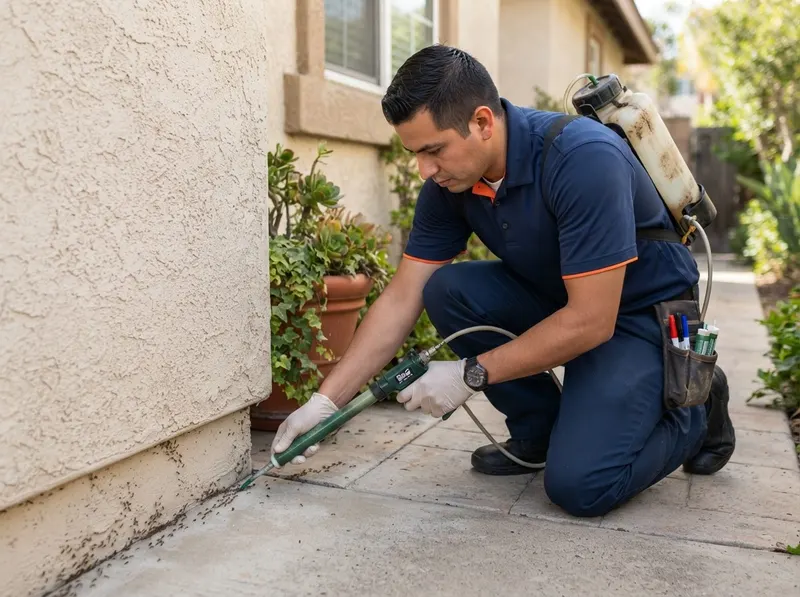
Argentine ants represent an entrenched, non-native supercolony across San Diego urban soil profiles, characterized by interconnected multi-queen subterranean nests that resist standard repellent barrier sprays. Our targeted vector control targets social foraging behavior. Technicians distribute professional-grade, slow-metabolizing carbohydrate and protein liquid bait reservoirs along exterior structural foundation perimeters and interior foraging trails. Worker ants ingest the active biological ingredients, transporting the payload deep into subterranean nesting chambers to nourish queens and developing broods over a 7-day to 14-day window. Simultaneously, technicians apply an exterior foundation perimeter band of micro-encapsulated non-repellent liquid compound 3 feet up the exterior stucco and 3 feet outward onto the soil or flatwork. This compound adheres to workers without triggering the defensive colony fracture or 'budding' mechanism caused by hardware-store sprays, steadily depressing overall queen fertility and reducing worker recruitment counts across the property.
Get a quote →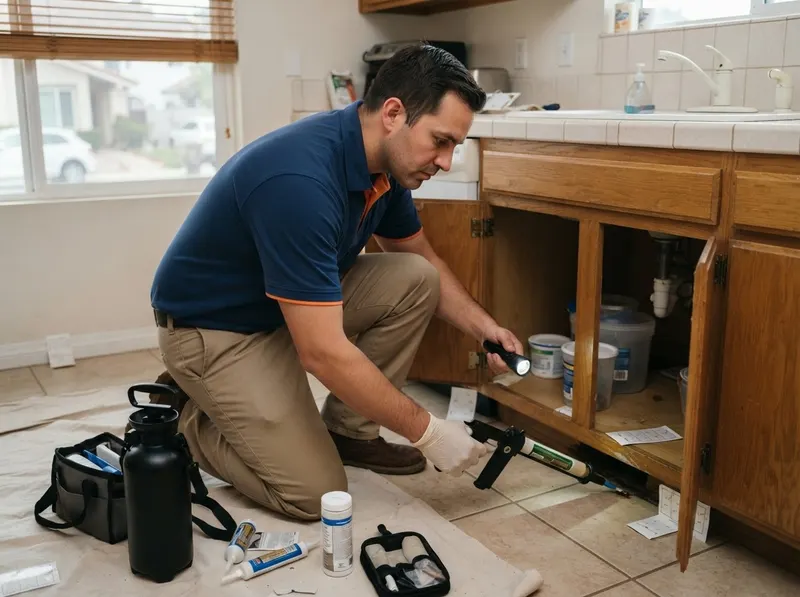
Interior German cockroach infestations generate severe allergen risks and food preparation contamination inside residential kitchens, bathrooms, and multifamily utilities. Our systematic cleanout sequence removes reproducing populations using targeted physical and chemical strategies. Technicians begin with commercial HEPA-filtered vacuum extraction to manually strip live adults, nymphs, and loose ootheca egg capsules from motor compartments behind refrigerators, dishwasher enclosures, and under-sink cabinetry. Following mechanical removal, technicians place high-attractant micro-bead gel baits inside deep structural cabinetry hinges, cabinet drawer tracks, and electrical wall plate margins. We then apply an odorless insect growth regulator (IGR) dust into concealed wall voids and plumbing service collars. The growth regulator disrupts juvenile insect chitin synthesis during normal molting, preventing juvenile nymphs from reaching reproductive maturity. Follow-up diagnostic inspections scheduled at 14 and 28 days ensure emerging egg casings are evaluated and neutralized until zero roach activity remains.
Get a quote →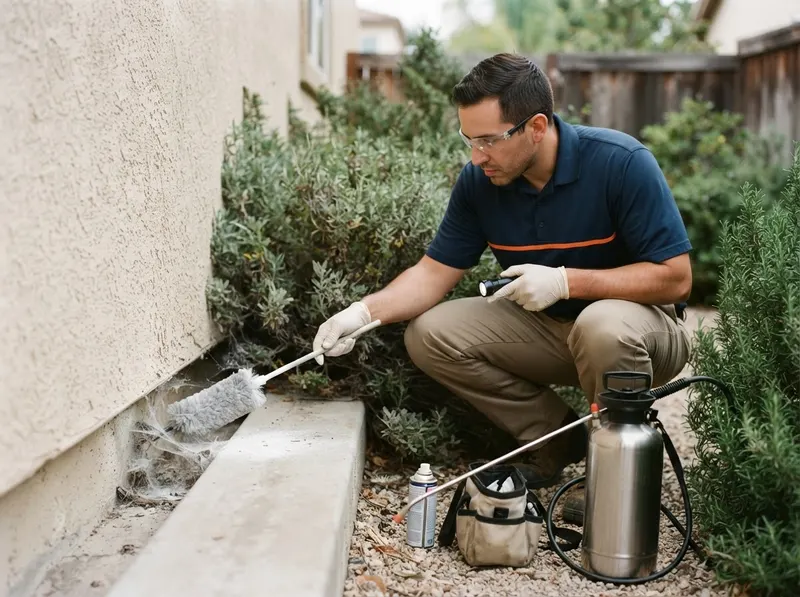
Western black widows build asymmetrical, high-tensile web retreats in dark, sheltered micro-environments including residential water meter boxes, sub-floor exterior foundation weep holes, retaining wall crevices, and garage storage corners. Our targeted habitat elimination protocol neutralizes adult populations while removing secondary hunting grounds. Technicians conduct physical web extraction using specialized electro-static telescoping brushes, safely eliminating sticky web architecture and visible silken egg sacs containing hundreds of developing spiderlings. Technicians then apply targeted micro-crystalline synthetic pyrethroid sprays directly into structural cracks, perimeter expansion joints, and weep screeds where arachnids shelter during daylight hours. To deliver long-term protection, technicians inject micronized inorganic silica dust into dry, sheltered crawlspace voids and utility access vaults. The desiccant dust adheres to the spider's waxy cuticle upon contact, causing rapid dehydration and mortality without leaving odorous chemical vapors inside the residential envelope.
Get a quote →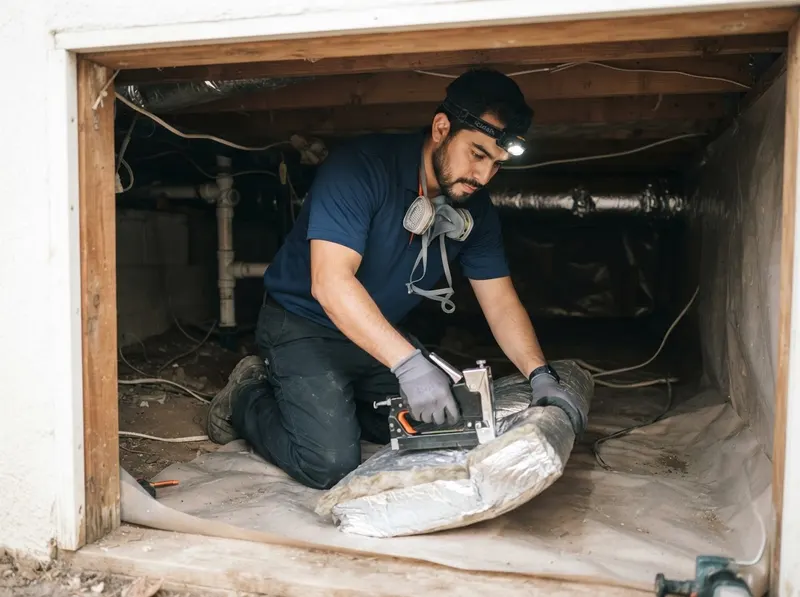
Biological contamination from historic rodent nesting, coupled with soil moisture accumulation inside residential crawlspaces, leads to framing decay, foul odors, and airborne fungal spores. Our crawlspace remediation service systematically restores sub-floor hygiene and environmental stability. Technicians enter the crawlspace to remove torn, rodent-stained, or displaced fiberglass insulation batts and soiled 4-mil to 6-mil polyethylene ground moisture barriers. Technicians utilize industrial HEPA-filtered negative-pressure vacuums to extract rodent droppings, nesting detritus, and structural debris without cross-contaminating interior living quarters. Following extraction, all exposed floor joists, subfloor sheeting, and foundation stem walls receive an antimicrobial and enzymatic misting application to neutralize bacterial pathogens and pheromone trails. Technicians conclude the remediation by installing heavy-duty 10-mil to 12-mil reinforced polyethylene vapor barrier sheeting across the soil, overlapping all seams by 12 inches, taping joints securely, and fastening the barrier to the perimeter concrete stem walls.
Get a quote →Commercial restaurants, brewpubs, and hospitality kitchens across San Diego face stringent health inspections requiring uncompromising pest-free operating environments. Our biosecurity service protocol provides comprehensive integrated pest management targeting flies, stored-product beetles, and nocturnal scavengers. Technicians apply biological enzyme foaming agents deep into commercial floor drains, breaking down the accumulated anaerobic grease and organic biofilm layers that host phorid and drain fly larvae. We inspect and install non-chemical ultraviolet insect light traps (ILTs) in critical back-of-house storage spaces, positioning them strategically away from food preparation lines to intercept flying insects. Detailed crack-and-crevice placements of heat-tolerant insect growth regulators are applied under cook lines, stainless prep tables, and dishwashing stations. Every service visit concludes with an itemized digital regulatory logbook audit detailing sanitation observations, structural gap corrections, and chemical usage logs to maintain compliance with San Diego County Department of Environmental Health standards.
Get a quote →You get a firm, itemized quote for your pest control sevice before any work begins, no surprises, no pressure.
Careful prep, tidy work, and a full cleanup when we are done. We treat your home and belongings like our own.
The same trusted, background-checked team from the first call to the final check.
Deciding on an intervention strategy requires balancing organism taxonomy, nesting architecture, and structural compromise against physical property access. If an inspection confirms localized drywood termite colonies inside structural rafters, fascia, or window headers with structural lumber integrity intact, select localized drill-and-inject borate or non-repellent liquid termiticide over whole-structure tent fumigation; this approach eliminates localized colony nodes immediately, avoids structural gas containment, and prevents homeowner displacement, though it trades off structural coverage of completely hidden structural voids that lack visual confirmation. If slab foundation perimeters display active mud tubes or subterranean workers moving from saturated soil into framing sill plates, select pressurized sub-slab injection and perimeter soil trenching using a non-detectable liquid termiticide; this establishes a continuous chemical boundary that foragers carry into subterranean reproductive nurseries, trading short-term exterior soil displacement for five to ten years of verifiable subterranean defense.
If foraging trails of Argentine ants emerge across interior baseboards, kitchen countertops, and plumbing penetrations, choose precision micro-gel baiting coupled with exterior perimeter non-repellent micro-encapsulated sprays over consumer-grade pyrethroid aerosol sprays; the bait matrices exploit mutual trophallaxis to distribute active insect growth regulators directly to multiple subterranean queens, preventing the colony-budding fracture response triggered by retail repellent sprays. If nocturnal noises, scratched drywall, or droppings indicate attic or crawlspace wildlife, select complete architectural exclusion paired with mechanical snap traps rather than anticoagulant rodenticide bait blocks; mechanical sealing using 1/4-inch 23-gauge galvanized steel mesh over gable vents, roof returns, and plumbing voids physically terminates access permanently, preventing rodents from expiring and decomposing within inaccessible wall cavities.
Every project gets a firm, written price after a free on-site visit. Ranges below for orientation.
Tell us about your pest control sevice job and we'll send a clear, written quote, usually the same day. Or just call and talk to a real San Diego pro.
(619) 935-5232
San Diego County encompasses complex environmental topography defined by distinct coastal marine layers, semi-arid inland valleys, and extensive native canyon networks that directly dictate residential biological activity. Properties in coastal neighborhoods such as Ocean Beach, Point Loma, Pacific Beach, and La Jolla face near-constant coastal marine moisture and morning fog rolling off Mission Bay Park and Cabrillo National Monument. This persistent atmospheric humidity softens exposed exterior framing lumber, fascia, and architectural shiplap siding, creating prime nesting conditions for drywood termite colonies that do not require ground moisture to consume timber. Furthermore, coastal coastal fog buffers winter temperatures, allowing invasive Argentine ant colonies to remain active year-round without entering full winter diapause. Moving eastward into inland valley corridors such as Clairemont Mesa, Mission Valley, Carmel Valley, and Scripps Ranch along the margins of Torrey Pines State Natural Reserve, environmental dynamics change dramatically. Inland residences experience severe dry heat cycles during summer months, followed by intense, high-velocity Santa Ana wind events in September and October. As ambient relative humidity drops below 15 percent across inland chaparral zones, wild Argentine ants abandon drying outdoor soil profiles and mount massive, synchronized invasions into residential structures, searching for water within plumbing wall chases, kitchen sink drains, and domestic refrigeration condensation lines. Simultaneously, residential construction bordering wild urban canyons encounters extreme roof rat and native rodent pressures. Rodents exploit mature bougainvillea vines, untrimmed date palms, and eucalyptus groves along canyon rims, using interconnected overhead utility cables to bypass street-level perimeter defenses. Between October and January, falling nighttime temperatures across inland San Diego drive rodents down into attic insulation voids, garage attics, and sub-slab crawlspaces, requiring robust architectural exclusion fabricated from gnaw-proof galvanized mesh rather than temporary chemical deterrents.
Free estimates for San Diego & the surrounding area.
 Bravion Bug Solutions